Weekly ecommerce tips, deals & news.
A wishlist merge is what happens to a guest’s saved items when they log in or create an account. The items held in their browser get combined with whatever is already on their account wishlist. Done properly, nothing is lost and the shopper never notices the handover.
So the merge is the moment a browser-only save becomes a customer record you can actually use.
Letting people save without an account is now standard. It removes a barrier at exactly the moment a shopper shows interest. However, it creates a second problem nobody plans for.
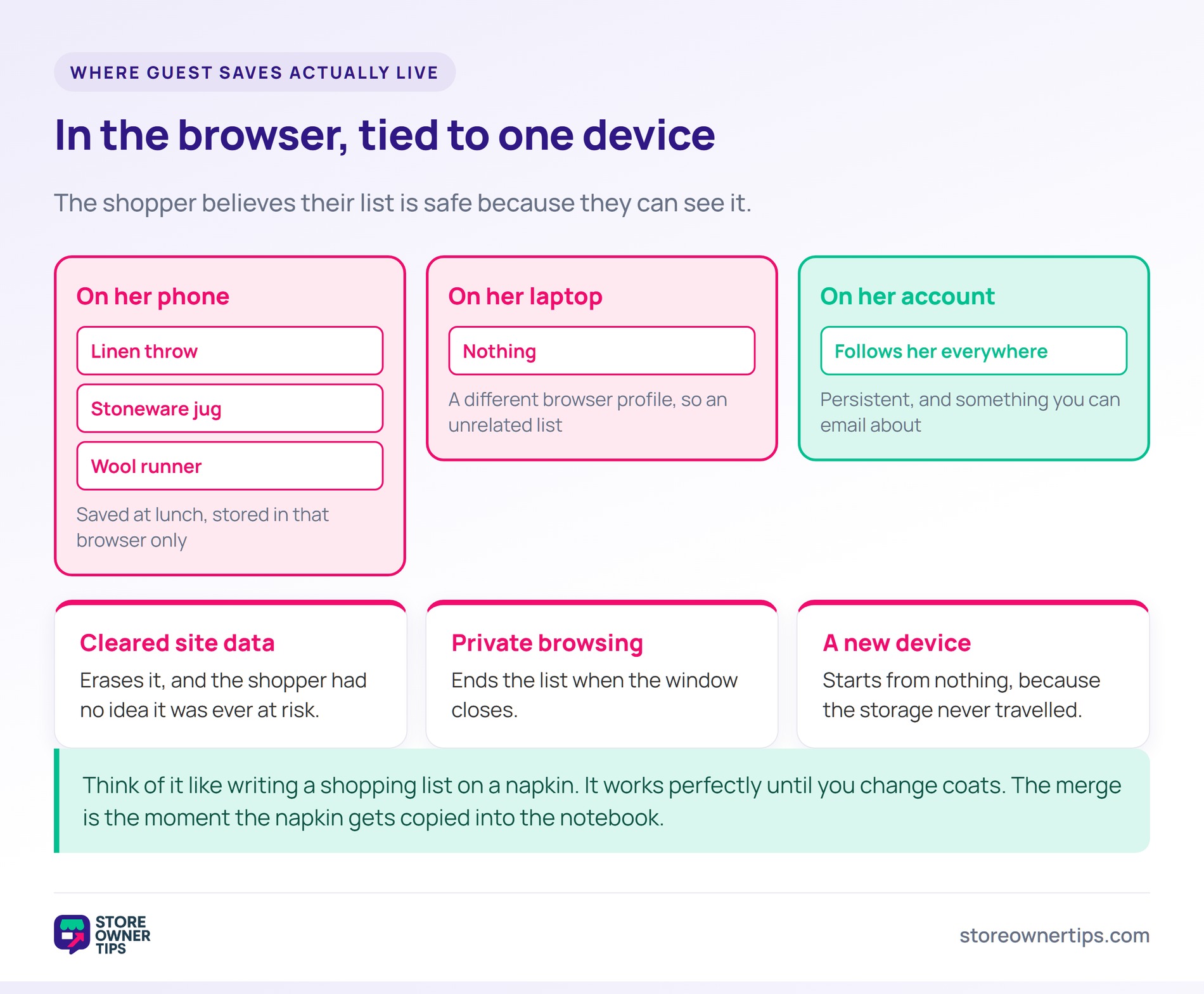
Those saves are sitting in a browser, and browsers forget.
An anonymous wishlist is normally stored in the visitor’s own browser. That storage is tied to one device and one browser profile. So the same person on a phone and a laptop has two unrelated lists.
It is also fragile. Clearing site data, using private browsing, or simply waiting long enough can erase it. Meanwhile, the shopper believes their list is safe because they can see it.
There is a privacy angle as well. Guest storage sits on a shared device as often as a personal one. So the merge should clear it once the transfer succeeds.
Think of it like writing a shopping list on a napkin. It works perfectly until you change coats. By contrast, an account wishlist is written in a notebook you keep.
The merge is the moment the napkin gets copied into the notebook. That is why a guest wishlist is only half a feature without one.
Forcing registration before any action costs real sales. Baymard Institute found that 18% of shoppers abandoned a cart because the site wanted them to create an account. Asking someone to register just to save an item invites the same reaction.
Friction generally is expensive here. The same research puts the average documented cart abandonment rate at 70.22%. Another 17% cited a checkout that was too long or complicated. So a registration wall in front of a wishlist is a bad trade.
Guest saving removes that wall. The shopper gets the feature immediately and you get a signal of intent. Meanwhile, the account can be offered later, when there is something worth protecting.
That later moment is exactly where the merge matters. A shopper with eight saved items has a reason to register that did not exist on their first visit.
The first rule is to combine rather than replace. A returning customer saves two items as a guest, then logs in. They must end up with their old list plus the two new ones. Overwriting either side is the classic bug.
Duplicates need handling quietly. If the same product exists on both lists it should appear once, not twice. So the merge deduplicates instead of stacking.
Timing matters as much as logic. The merge should fire on login and on registration, not only on one of them. Otherwise half your shoppers still lose their items.
Once an account exists, the saved list becomes actionable. An email wishlist reminder can nudge a shopper who has gone quiet. A back-in-stock notification finally has somewhere to arrive. Meanwhile, abandoned wishlist recovery only works when an address is attached.
Once merged, the list becomes persistent and follows the shopper across devices. That is the real prize. Meanwhile, it also becomes something you can email about.

Imagine a homeware store called Thistle & Pine selling ceramics and textiles. Shoppers browse on a phone at lunch and buy on a laptop in the evening. Previously the store allowed guest saving with no merge.
A visitor saves six items on her phone during the week. On Saturday she opens the site on a laptop and creates an account to check out. Her list is empty.
From her side the store simply lost her selections. She does not know about browser storage, and she should not have to. So she rebuilds two items from memory and forgets the rest.
Thistle & Pine never sees the loss. The saves happened, the account exists, and nothing errored. Meanwhile, four items of demonstrated interest quietly disappeared.
Guest saves now transfer on login and on registration. The same visitor registers and finds all six items waiting. So the account instantly feels worth having.
The commercial effect is downstream rather than immediate. Those six items are now attached to an email address, which makes reminders and alerts possible. Previously there was nobody to send anything to.
Registration also rises without any new incentive. Shoppers with a full guest list have a concrete reason to create an account. In practice, the prompt writes itself: keep these six items.
Multiple lists behave the same way. If a shopper built multiple wishlists as a guest, each should survive the merge intact. Otherwise the merge solves one problem and creates another.
The store starts watching its add-to-wishlist rate next to registrations. Saves were never the problem, retention of them was. Meanwhile, the fix required no change to the catalog or the checkout.

Stores often build one and assume it covers the other. They behave differently because the intent behind them differs. A cart says buying now, while a wishlist says maybe later.
Cart merges are usually short-lived and urgent. The session is minutes or hours old and the shopper is mid-decision. So losing a cart is noticed immediately and complained about.
Wishlist merges span weeks. Items may have been saved across several visits and devices before anyone logs in. Meanwhile, losing them is silent, which is exactly why it goes unfixed.
The related idea is save for later, which sits between the two. Whatever you call it, the merge rule is the same. Combine both sides, deduplicate, and never overwrite.

Never. A returning customer may have months of saves on their account and two items from today’s guest session. Replacing one with the other throws away the more valuable list.
Always add the guest items to the account list and remove duplicates. So the result is a superset of both. Meanwhile, the shopper sees more than they expected rather than less.
As long as the browser keeps them, which is not something you control. Clearing site data, private browsing or a new device all end it. So treat guest saves as temporary by design.
That uncertainty is the argument for prompting earlier. A gentle nudge to save the list properly after a few items is more useful than one at checkout. In practice, the prompt works best right after the second or third save.
It happens, and the merge cannot tell them apart. One person’s guest saves can end up on another person’s account after login. So the account holder sees items they never chose.
The practical answer is easy removal rather than clever detection. Make deleting an item from the list obvious and quick. Meanwhile, clearing guest storage after a successful merge stops it repeating.
Guest wishlists remove a barrier, and the merge is what stops that convenience quietly costing you data. Combine both lists, deduplicate, fire on login and registration, and never overwrite.
Then use the full list as the reason to register. For how this works in practice, see this guide to WooCommerce guest user wishlists.
Copyright © StoreOwnerTips.com. All Rights Reserved.
