Weekly ecommerce tips, deals & news.
A distributor is a business that buys goods from a manufacturer and resells them to retailers. That reselling usually happens within an agreed territory. A distributor takes ownership of the stock, stores it, and handles selling work the manufacturer would otherwise do. Distributors represent a limited set of brands, which is what separates them from a general bulk seller.
A distributor works by buying stock from a manufacturer, holding it, and then selling it onward to retailers. The distributor signs an agreement with the manufacturer covering territory, pricing, and obligations. From there, the distributor carries the inventory and the cash risk. Retailers order from the distributor rather than chasing the factory directly.
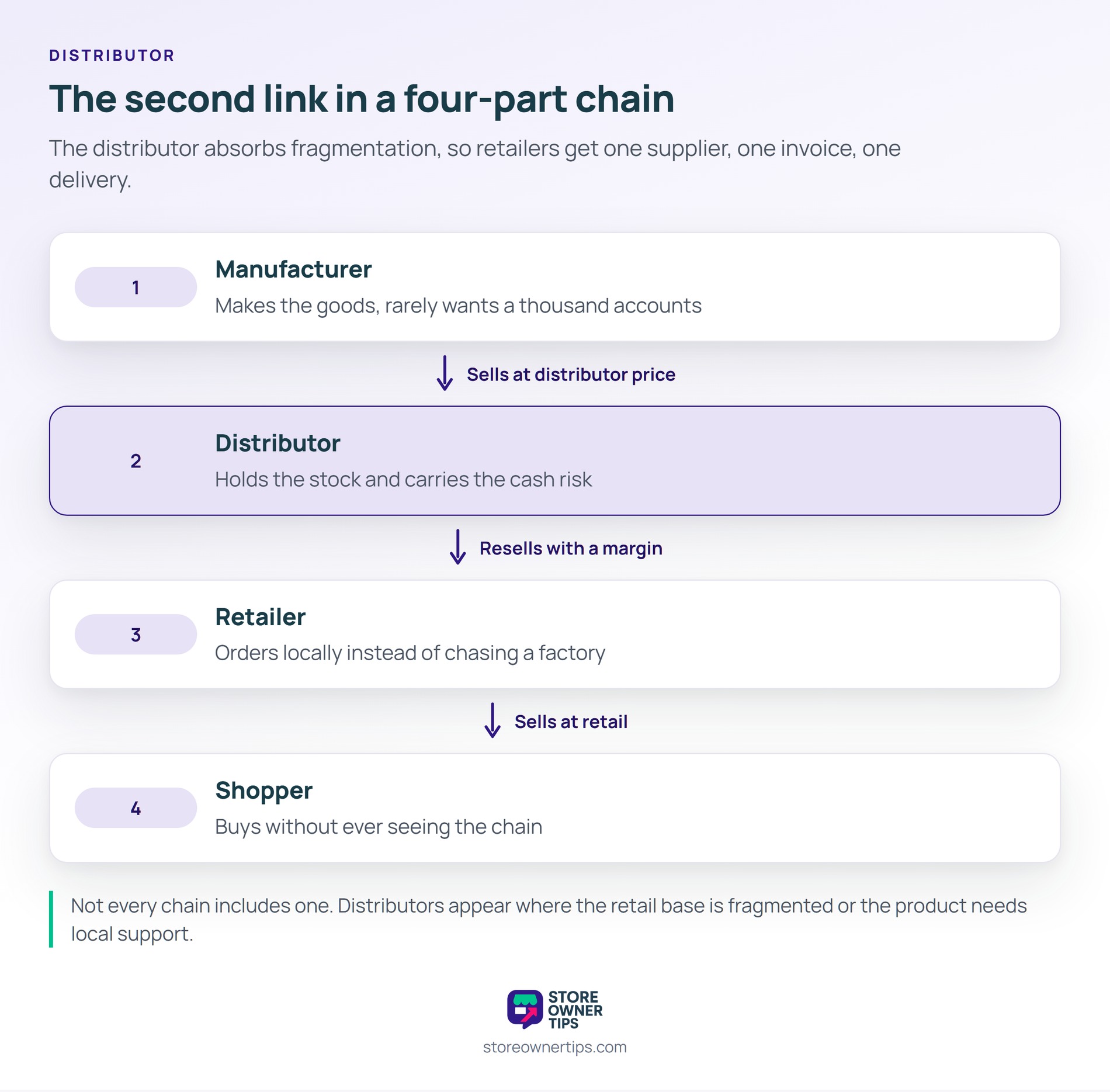
A distributor sits in the second link of a four-part chain: manufacturer, distributor, retailer, shopper. First, the manufacturer makes the goods but rarely wants to sell to a thousand small shops. The distributor absorbs that fragmentation. Retailers then get one supplier, one invoice, and one delivery schedule.
Think of a distributor as a regional agent for a brand. An agent does not make the product, but they know the local market and carry the relationships. For example, they know which shops pay on time and which stock competing lines.
Not every chain includes a distributor. Some manufacturers sell straight to retailers, and some sell straight to the public. In practice, distributors appear where the retail base is fragmented or the product needs local support.
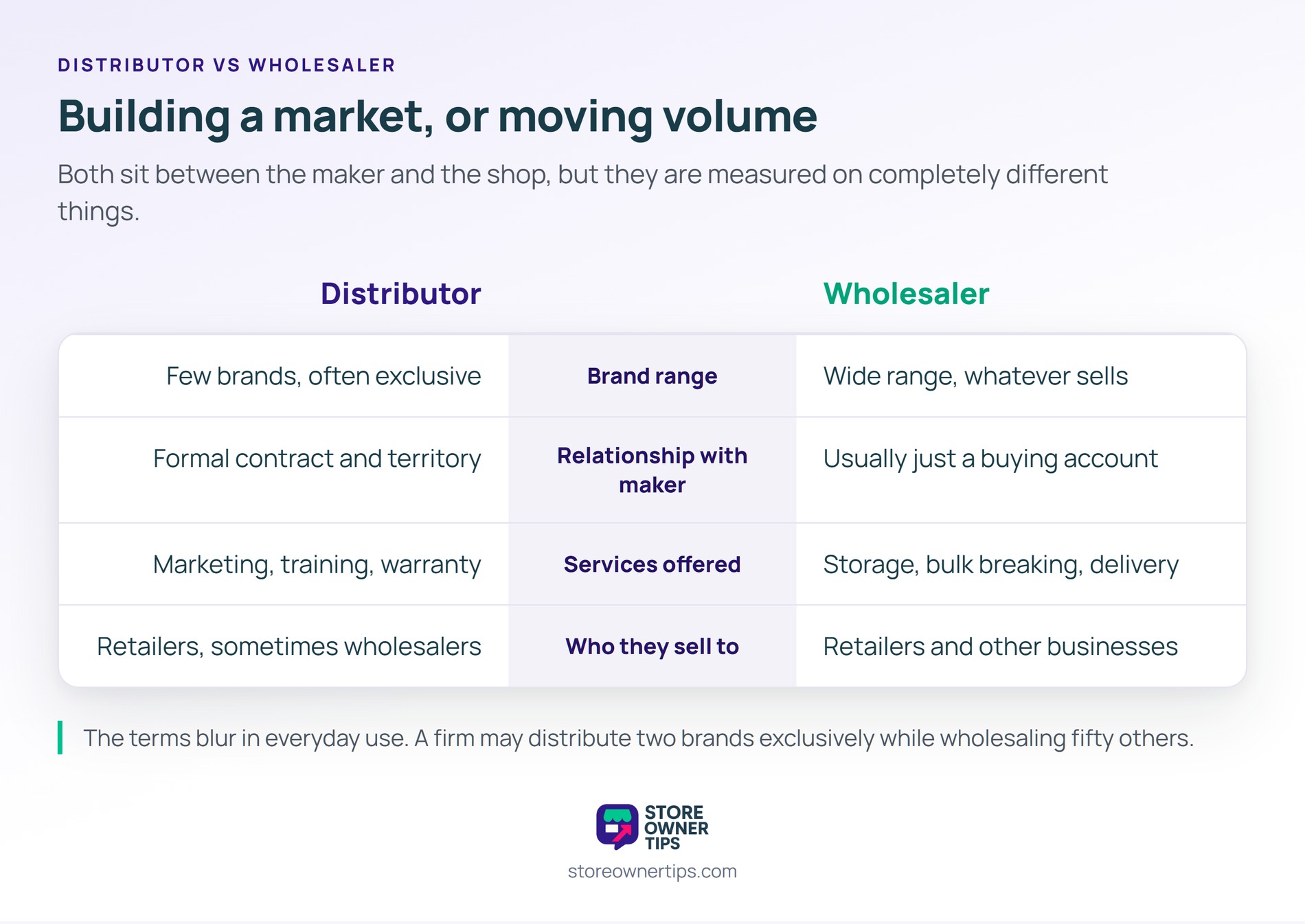
A distributor does four jobs that a manufacturer would otherwise handle alone. First comes stockholding, which means buying inventory up front and warehousing it. Next comes selling, through reps who call on retail accounts. Then comes support, covering product training, demos, and warranty handling.
The fourth job is credit. Distributors commonly extend payment terms to retailers, which means shipping goods now and collecting later. Setting a sensible credit limit per account is a core distributor skill. Get it wrong and the business runs out of cash while technically profitable.
Territory is the other defining feature. Many distribution agreements grant exclusive rights to a region. As a result, the distributor invests in building that market without a rival undercutting them on the same brand.
Exclusivity is not the only model, though. Non-exclusive deals let a manufacturer appoint several distributors in one territory. That widens coverage quickly, but it also invites price competition between partners carrying the same line.
Holding stock locally is what makes the whole arrangement useful. A retailer ordering from a factory overseas may wait weeks for delivery. By contrast, a distributor with regional warehouse space cuts that lead time to days. Short lead times are often the real product a distributor sells.
A distributor makes money on the spread between the buying price and the selling price. First, the manufacturer sells at a distributor price, which sits below normal wholesale pricing. The distributor then resells to retailers at a higher rate. That margin has to cover warehousing, sales staff, delivery, and bad debt.
Meanwhile, volume commitments usually come attached. Manufacturers grant distributor pricing in exchange for a promised annual quantity. A minimum order quantity often applies to each individual order too.
Cross-border distribution adds another layer. The 11 Incoterms rules published by the International Chamber of Commerce decide who pays freight and who carries risk. Distributors negotiate those terms carefully, since Incoterms can move real cost between the parties.
Distribution is one of the largest and least visible parts of the economy, and government data shows the scale plainly. The US Census Bureau tracks merchant wholesalers, a category that includes industrial distributors, exporters, and importers. Its annual figures run into the trillions of dollars.
The more useful number for operators is the inventories-to-sales ratio. Census reported a merchant wholesaler ratio of 1.19 in a recent month, against 1.30 a year earlier. A ratio of 1.19 means roughly 1.2 months of stock sitting on hand.
That single figure explains the whole business model. Distributors are paid to hold inventory so that manufacturers and retailers do not have to. In short, the ratio is the cost of the service they sell.
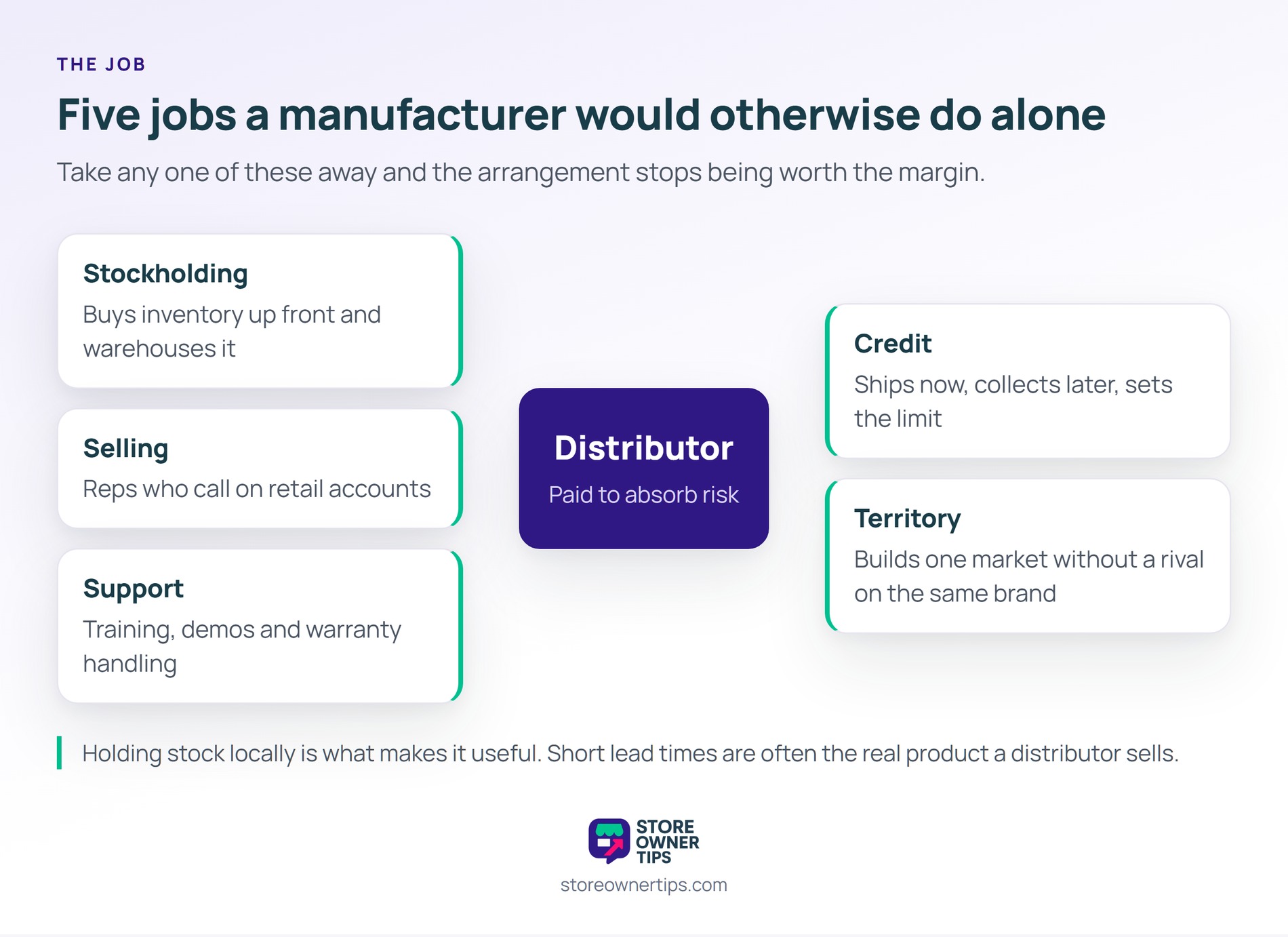
Here’s a hypothetical example. Imagine a small manufacturer that makes speciality cleaning products for commercial kitchens. The founder sells direct to about thirty restaurants. Growth has stalled, because selling takes more hours than the founder has.
In practice, the manufacturer signs a distributor who already supplies catering equipment across one region. The agreement grants exclusivity in that region for two years. In exchange, the distributor commits to a minimum annual volume.
Next, pricing is set in three tiers. The manufacturer sells to the distributor at the deepest discount. The distributor resells to restaurants at a rate closer to standard trade pricing. Both parties agree that the manufacturer will not undercut the distributor online.
In this scenario, the manufacturer trades margin for reach. Revenue per unit falls, because the distributor takes a cut. Meanwhile, total volume rises sharply, since the distributor already visits hundreds of kitchens every month.
As a result, the founder also gets time back. Order handling, credit chasing, and delivery all move to the distributor. That frees the founder to work on new products instead of new accounts.
Still, the scenario has a real risk worth naming. The manufacturer now has one large customer instead of thirty small ones. If the distributor walks away, the entire region disappears with them.
Visibility is the second cost. The manufacturer no longer sees which restaurants reorder, or how often. That information now sits with the distributor, and it rarely comes back in full.
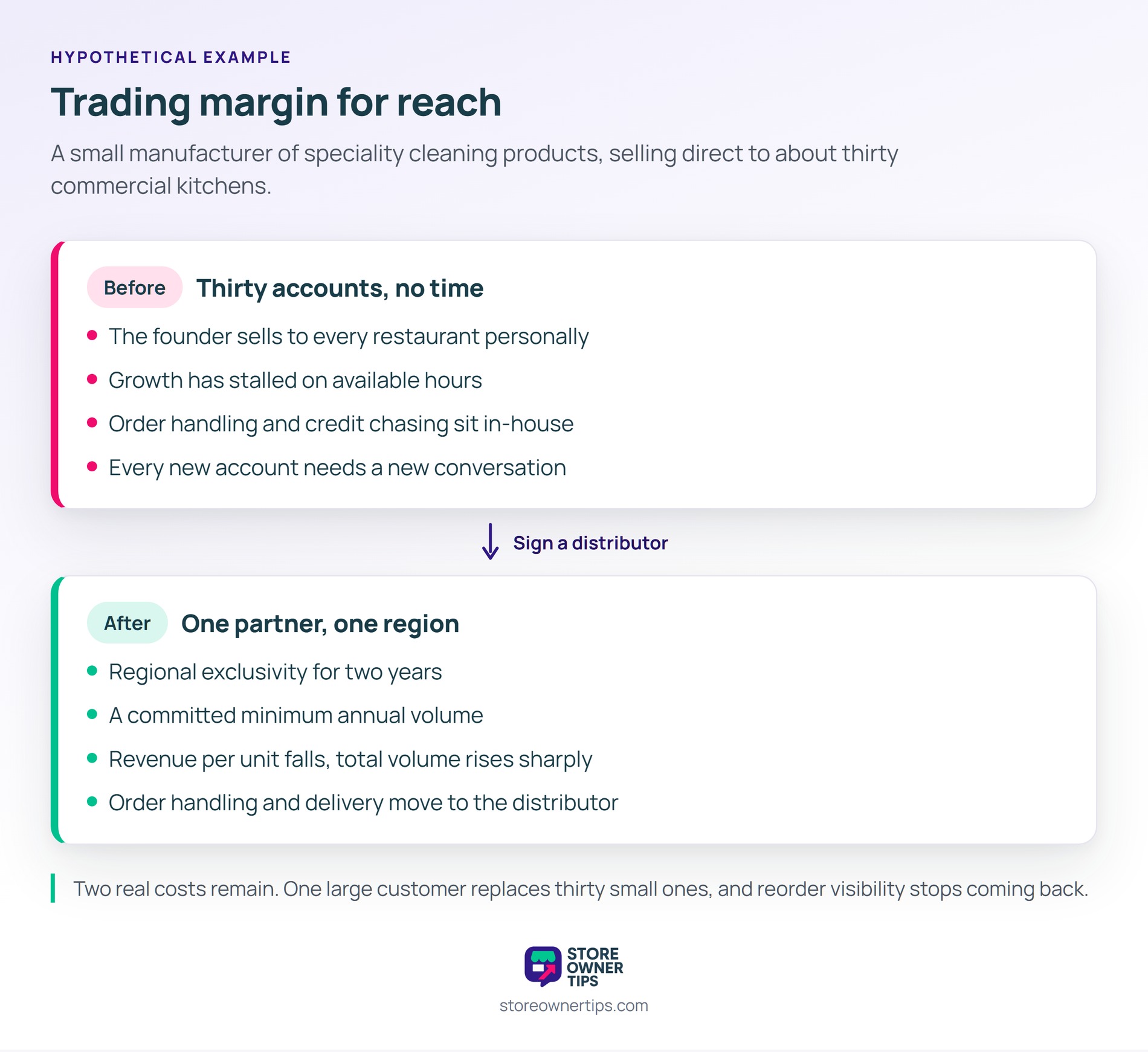
| What you’re comparing | Distributor | Wholesaler |
|---|---|---|
| Brand range | Few brands, often exclusive | Wide range, whatever sells |
| Relationship with maker | Formal contract and territory | Usually just a buying account |
| Services offered | Marketing, training, warranty support | Storage, bulk breaking, delivery |
| Who they sell to | Retailers, sometimes wholesalers | Retailers and other businesses |
A distributor and a wholesaler both sit between the maker and the shop, but they play different roles. A distributor builds a market for specific brands and is measured on how well those brands grow. A wholesaler moves whatever is in demand and is measured on turnover.
That said, the terms do blur in everyday use, and plenty of businesses do both. For example, a firm may distribute two brands exclusively while wholesaling fifty others.
No, though a distributor is one kind of supplier. Supplier is a broad word for anyone who sells you goods. A distributor is a specific role, defined by buying from a manufacturer and reselling within an agreed territory. Every distributor is a supplier, but most suppliers are not distributors.
Sometimes, but the manufacturer often says no. In practice, many brands route all retail orders through distributors to protect territory agreements. Others set volume floors that a single shop cannot meet. Buying direct usually becomes possible only once a retailer’s order size justifies the manufacturer’s attention.
Distributors set the price they charge retailers, not the price shoppers pay. The manufacturer may publish a suggested retail figure as guidance. Retailers remain free to price as they choose in most markets. Some brands do enforce advertising rules on the lowest price a retailer may promote.
Distributors matter because they decide which products actually reach shelves. A brand with no distribution partner competes only where it can sell directly. For a growing manufacturer, picking a distributor is a decision about reach and margin. It also decides how much of the wholesale customer relationship you hand away.
Copyright © StoreOwnerTips.com. All Rights Reserved.
