Weekly ecommerce tips, deals & news.
A coupon expiration date is the point at which a discount code stops working. After it passes, the code is rejected at checkout and the offer is over. It is the setting that gives a promotion an ending, and most coupons created without one never really end.
So the expiry is what makes a discount a campaign instead of a standing price cut.
Setting an end date feels like an administrative detail. It is closer to a pricing decision. However, most stores treat it as the last field on the form rather than the first.
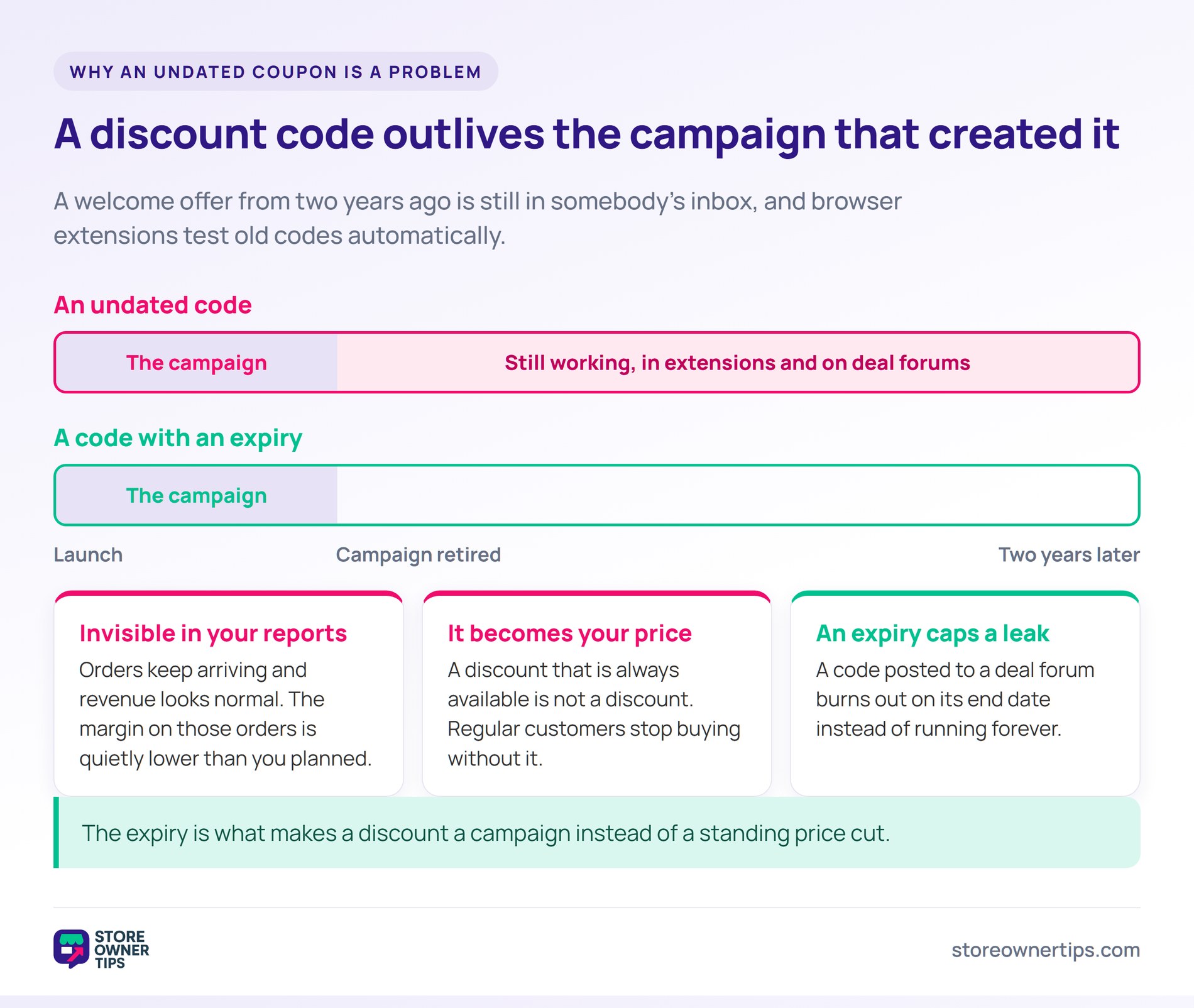
The date decides both how urgent the offer feels and how long you are exposed to it.
A discount code outlives the campaign that created it. A welcome offer from two years ago is still in somebody’s inbox, and browser extensions test old codes automatically. So an undated code keeps discounting long after you stopped thinking about it.
The damage is invisible in the usual reports. Orders keep arriving and revenue looks normal. Meanwhile, the margin on those orders is quietly lower than you planned.
There is a positioning cost as well. A discount that is always available is not a discount, it is your price. Over time, regular customers simply stop buying without it.
An expiry also caps the damage from a leak. A code posted to a deal forum burns out on its end date instead of running forever. In practice, that is the cheapest containment available.
A deadline converts intention into action. Shoppers who would have thought about it now have a reason to decide today. That pressure is the scarcity principle applied to time rather than stock.
The related pull is FOMO, the discomfort of missing something others will get. Both work best when the deadline is close enough to feel real. Meanwhile, a code valid for six months creates no pressure at all.
Urgency only helps if people actually redeem, though. One peer-reviewed study of a national sample found that 17.6% of its 1,146 participants had redeemed a coupon. That was a specific population, so treat it as illustration rather than a target.
The wider point is that most issued coupons go unused. So the deadline is one of the few levers that reliably converts a holder into a buyer.
Match the length to the offer’s job. A flash sale wants hours, because the whole point is compression. By contrast, a first-order discount needs long enough for a new visitor to return and decide.
Recovery offers sit in the middle and are the most timing-sensitive of all. A cart abandonment discount arriving three days later is competing with a decision already made. So hours matter more than days there.
Be careful at the checkout itself. Baymard Institute puts the average documented cart abandonment rate at 70.22%. A code that silently expires mid-session turns a near-sale into a support ticket.
Finally, say which time zone applies. “Ends Friday” is ambiguous to anyone outside yours, and a shopper who missed it by two hours feels cheated. In practice, stating the zone costs nothing and prevents that entirely.
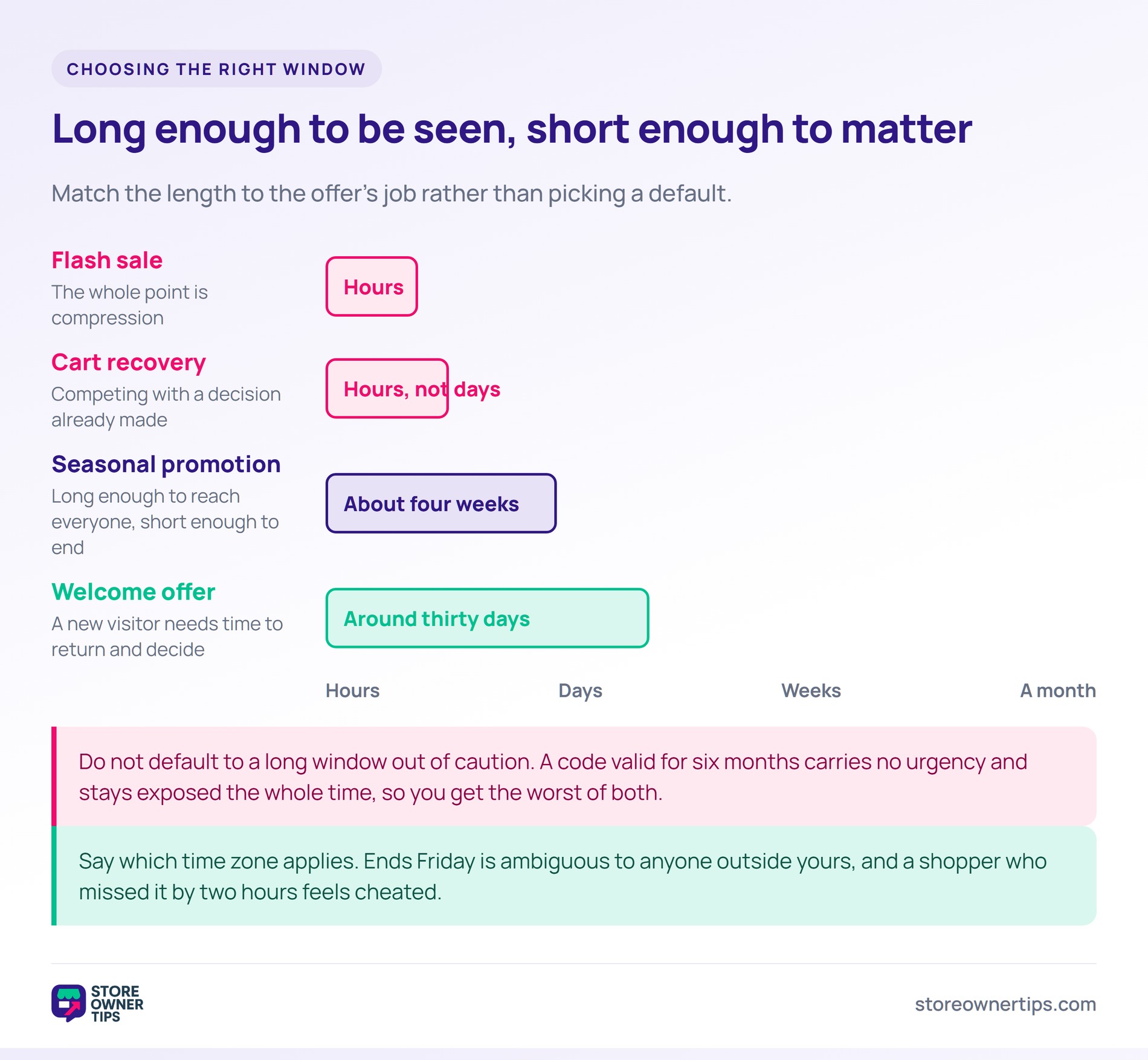
Imagine a stationery store called Margin selling notebooks and pens. It ran a spring promotion with a SPRING15 code. Previously that code was created with no end date.
Spring ends and the campaign is retired from the marketing calendar. Nobody deactivates the code, because nobody remembers it exists. So SPRING15 keeps working through summer and autumn.
By November it is in three coupon extensions and one deal forum. Shoppers who never saw the spring campaign now get fifteen percent automatically. Meanwhile, Margin’s reports show healthy revenue and nothing obviously wrong.
Say a typical order is $70 at a 50% gross margin, so $35 of profit. Fifteen percent takes $10.50 off, leaving $24.50. That single forgotten field removed 30% of the profit on every affected order.
Margin adopts a simple rule: no coupon is created without an expiry. The spring code now dies on the last day of the campaign. So the leak has a natural end even if nobody notices it.
The team also shortens the windows deliberately. Seasonal codes run four weeks rather than open-ended, and recovery emails carry a 48-hour code. Meanwhile, the welcome offer keeps a thirty-day window because new visitors need time.
Communication changes too. Every email now states the end date and the time zone in the same line as the code. In practice, that alone removed most of the “my code stopped working” messages.
One refinement follows a complaint. A shopper lost a code while filling in checkout, so Margin now sets expiry times outside peak shopping hours. That way nothing dies mid-session.
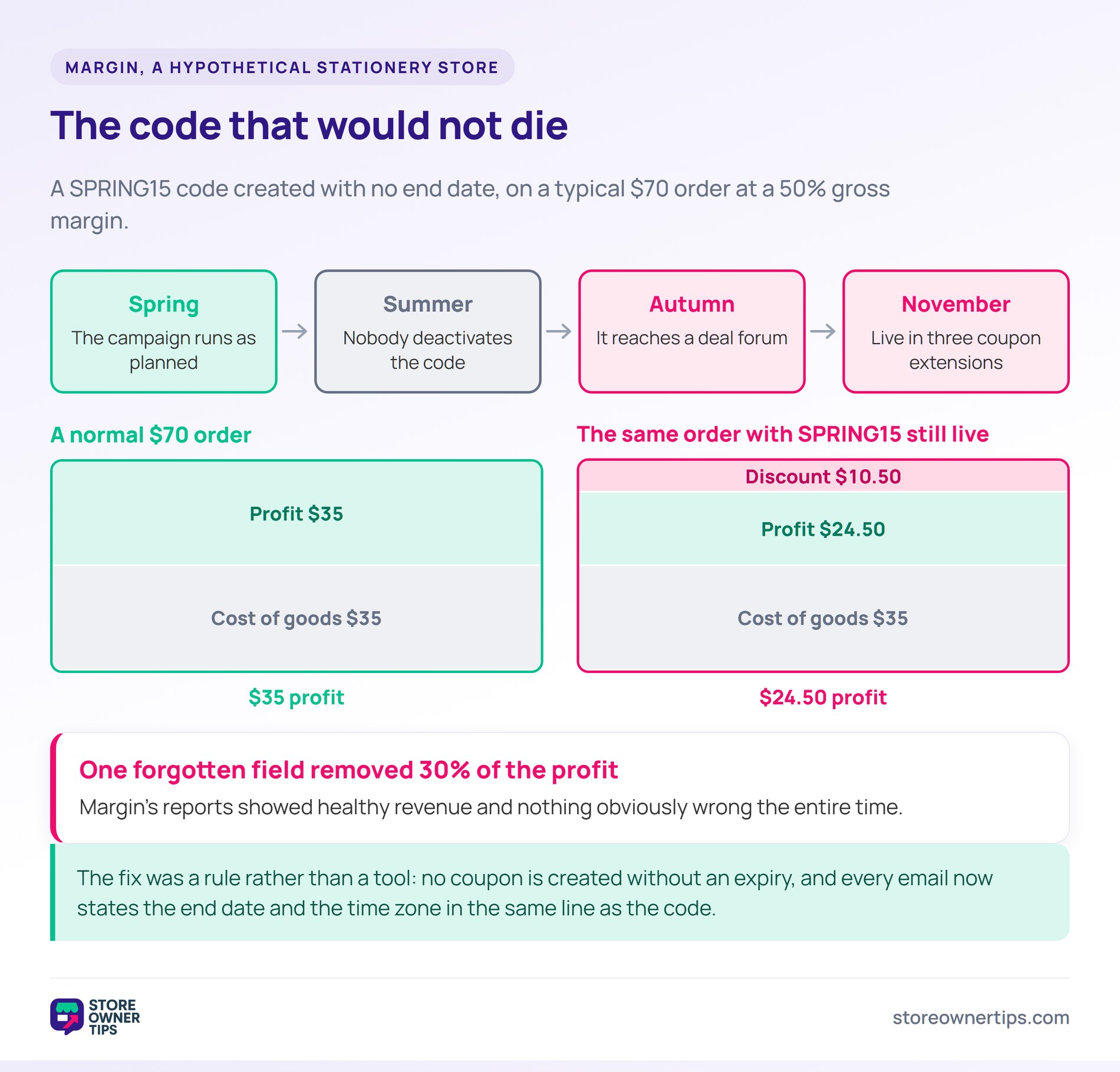
Coupons have two dates and stores usually set only one. The expiry closes the offer, while the start date opens it. Both are needed to place a promotion properly in time.
A start date lets you build the campaign in advance. You can create codes, write the emails and schedule everything without the offer going live early. So launch day needs no manual switch.
Together the pair is what makes a scheduled discount possible. The offer opens and closes on its own. Meanwhile, nobody has to remember to turn anything off at midnight.
Setting only an expiry still leaves a gap. The code works from the moment it is created, so an early leak discounts sales before the campaign even starts. By contrast, a start date closes that window.
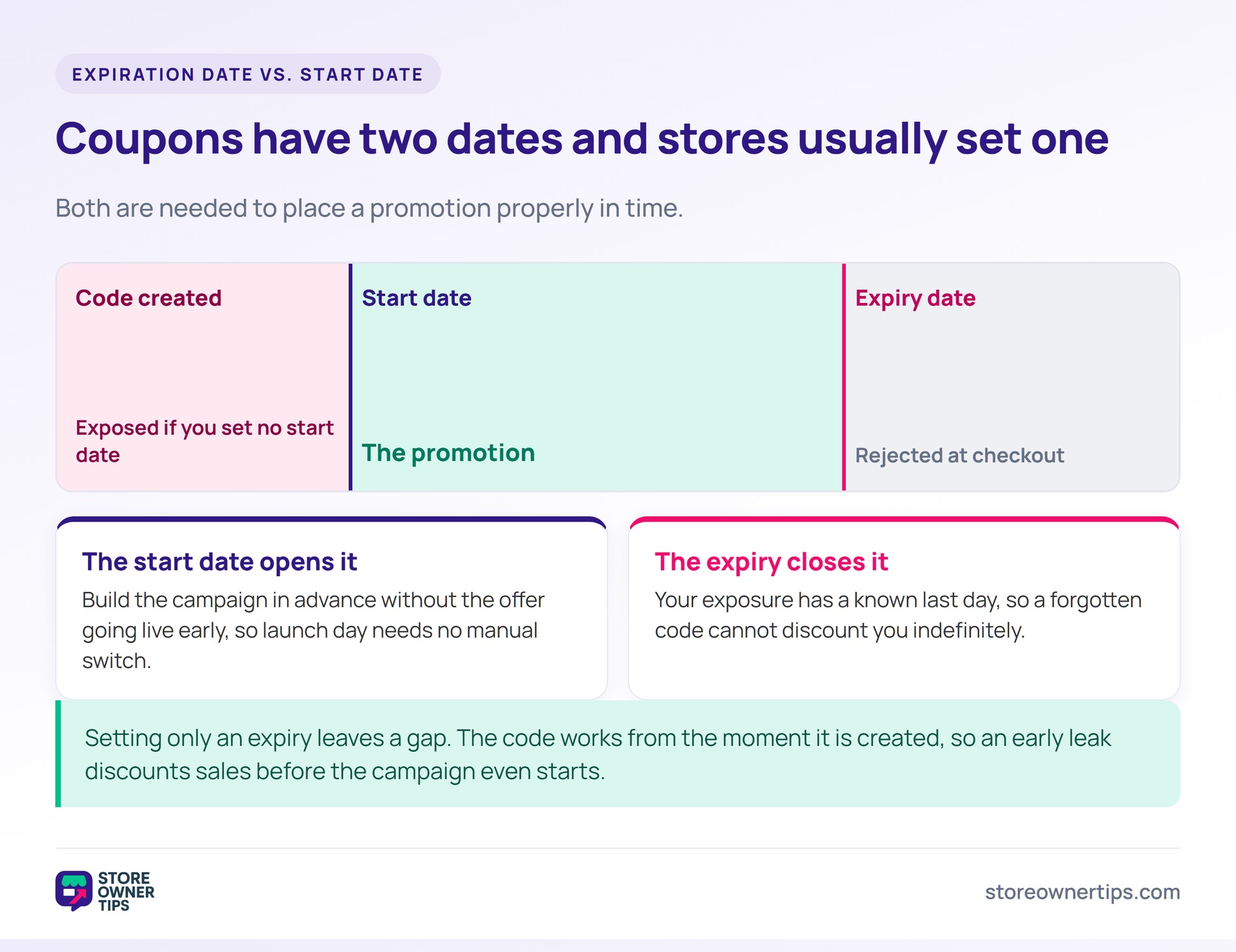
Long enough to be seen, short enough to matter. Match the window to the offer’s job rather than picking a default. So a recovery code runs in hours and a welcome code runs in weeks.
The common mistake is defaulting to a long window out of caution. A code valid for six months carries no urgency and stays exposed the whole time. Meanwhile, you get the worst of both.
Usually yes, quietly, for a genuine near miss. Honoring a code that lapsed hours ago costs one discount and keeps a customer. By contrast, refusing on principle costs the order and often a review.
Do it case by case rather than announcing a policy. If shoppers learn that expired codes still work, the deadline stops meaning anything. In practice, a one-off dynamic coupon is cleaner than reopening the original.
The message matters more than the block. A generic “invalid coupon” error suggests your store is broken rather than that the offer ended. So say plainly that the promotion has finished.
Better still, point them somewhere useful. A line offering the current promotion turns a dead end into a second chance. Meanwhile, the shopper is already at checkout with intent.
An expiration date is the difference between running a promotion and permanently lowering your prices by accident. Set one on every code, match the window to the offer, and always state the time zone.
Then avoid end times that land in peak shopping hours. For the setup itself, see this guide to setting coupon expiration dates in WooCommerce.
Copyright © StoreOwnerTips.com. All Rights Reserved.
