Weekly ecommerce tips, deals & news.
Hreflang is an HTML attribute that tells search engines which language and regional version of a page to show each visitor. You add it to pages that hold the same content in different languages or for different countries. It helps the right person see the right version in search results, instead of landing on one they cannot read.
Think of hreflang like a multilingual receptionist at a hotel front desk. A guest walks up, and the receptionist quietly routes them to a colleague who speaks their language. Hreflang does the same job for your web pages. It tells search engines, “This page is the French version, and that one is the German version.”
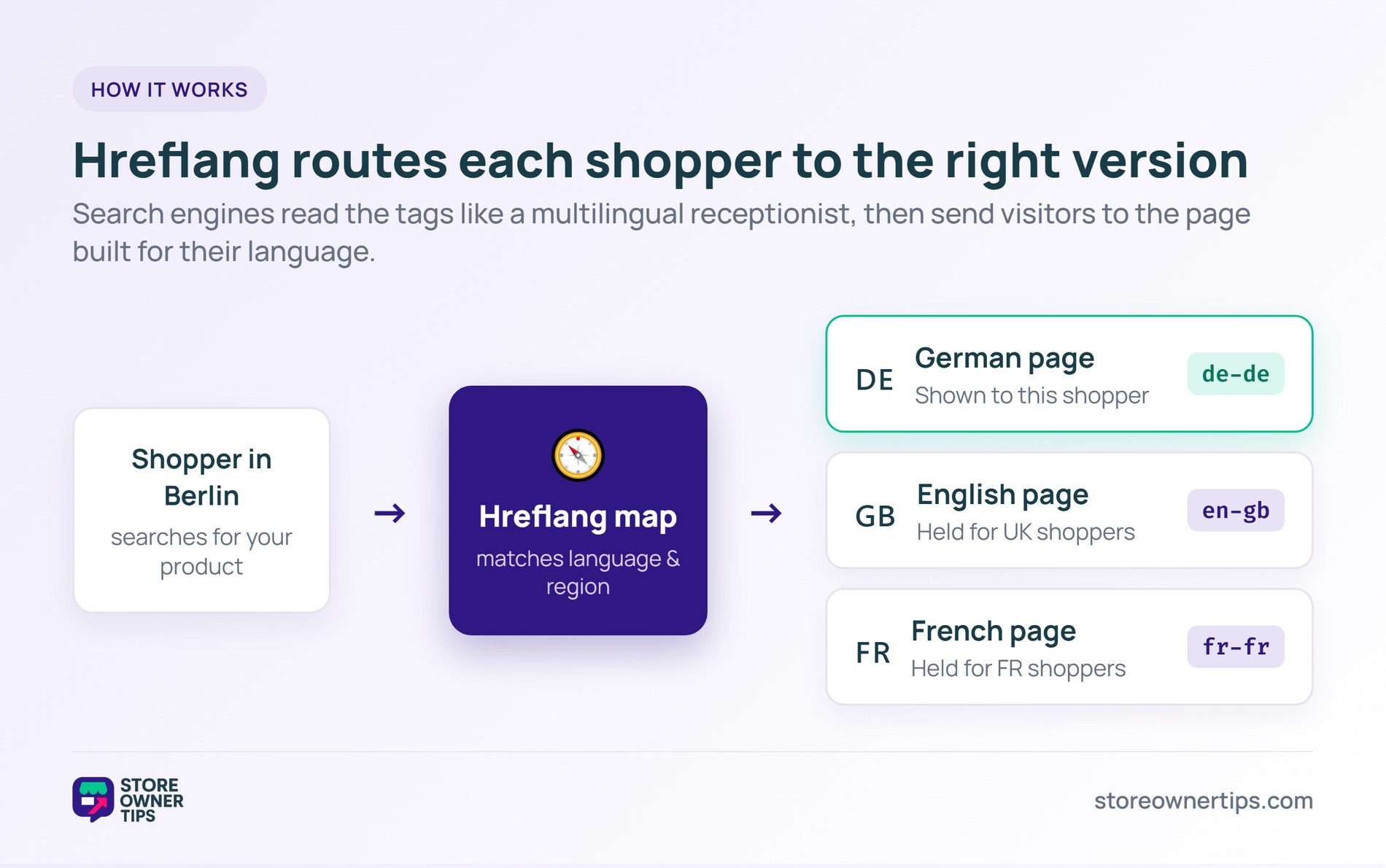
That routing matters more than it sounds. When you sell across borders, the same product can live on several pages, one per language or country. Search engines need a clear map, or they guess. Hreflang hands them that map so the guessing stops.
An hreflang value has two parts. First comes the language code, written in ISO 639-1 format, like en for English. Next comes an optional region code, written in ISO 3166-1 Alpha 2 format, like en-au for Australian English.
You can add hreflang three ways. You can use HTML tags in the page head, HTTP response headers, or an XML sitemap. Google treats all three methods as equal, so pick whichever fits your store best. Most store owners lean on an SEO plugin like Yoast or AIOSEO, or a built-in app, to write these tags for them.
There is also a special value called x-default. It marks a fallback page for visitors whose language you have not targeted. Think of it as the “everyone else” door when no other version fits.
One quick note on scope. Hreflang connects pages across your site, much like internal linking connects related content. The difference is that hreflang links translated equals, not just related topics. Both habits help search engines understand how your pages relate.
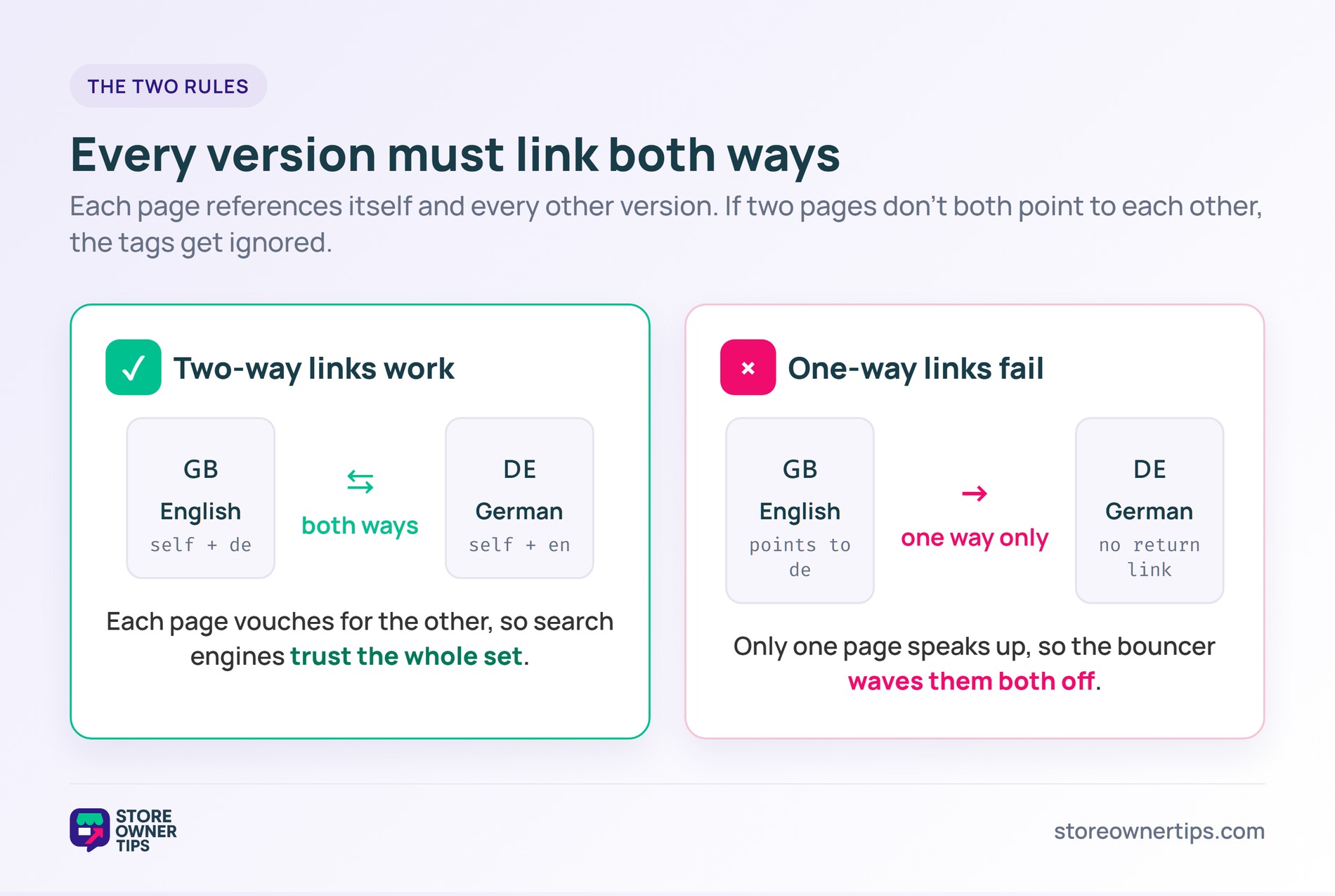
Two rules matter most. First, each version must reference itself plus every other version. Second, the links must point both ways. As Google puts it, if two pages don’t both point to each other, the tags will be ignored.
Picture two friends vouching for each other at a club door. If only one speaks up, the bouncer waves them both off. Hreflang works the same way, since one-sided links carry no weight.
One more thing surprises store owners. Hreflang does not set your page language for Google. Google uses its own algorithms to read the language, then uses hreflang to match the right version to the right searcher.
Selling across borders means the same product page may exist in several languages. Without guidance, search engines can show the wrong one or treat them as duplicates. Hreflang clears up that confusion at the source.
The payoff is relevance. A shopper in Berlin lands on your German page, not your English one. That smoother match tends to lift clicks and trust, which supports your broader organic traffic goals across every market you serve. It also keeps your translated pages from quietly competing against each other.
Imagine a mid-sized tea brand called Leafline. It sells from a WooCommerce store and ships to English-speaking and German-speaking customers. The team builds two versions of each product page, one in English and one in German.
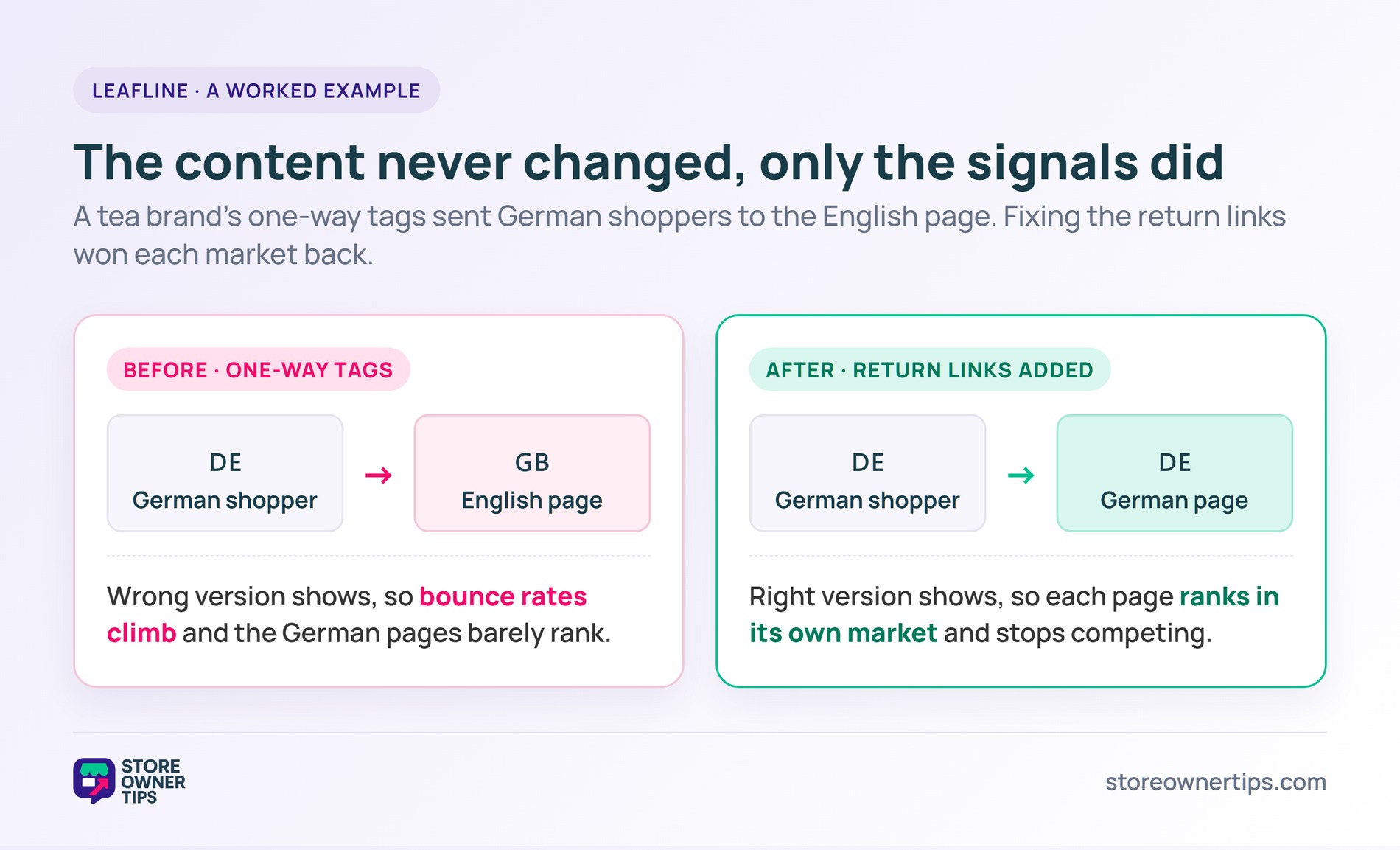
At first, German shoppers keep landing on the English page in search results. Bounce rates climb, and the German pages barely rank. The team suspects a duplicate content tangle and starts digging into the technical setup.
They are not alone in this. One analysis found that 31.02% of websites serving multiple languages have conflicting hreflang directives. Leafline turns out to be one of them, with tags that point in only one direction.
The team adds proper hreflang tags to both pages. Each page now references itself and its counterpart, with matching return links. They also confirm each page has a self-referencing canonical, so no signals contradict each other.
That detail matters, because missing self-references are rampant. In one study of 20,000 multilingual sites, a missing self-referencing tag appeared in 96% of source-code conflicts. Leafline patches that gap first.
After the fix, German searchers start landing on the German page. Those pages begin ranking in their own market, and bounce rates settle down. The English pages hold steady too, since they no longer compete with the translations.
The lesson is simple. The content never changed, only the signals did. Clean hreflang turned two pages that fought each other into two pages that each won their own audience.
Leafline now treats hreflang as routine. Every time the team adds a language, they update the full set of tags together. That discipline keeps the cluster healthy and stops one-sided links from creeping back in.
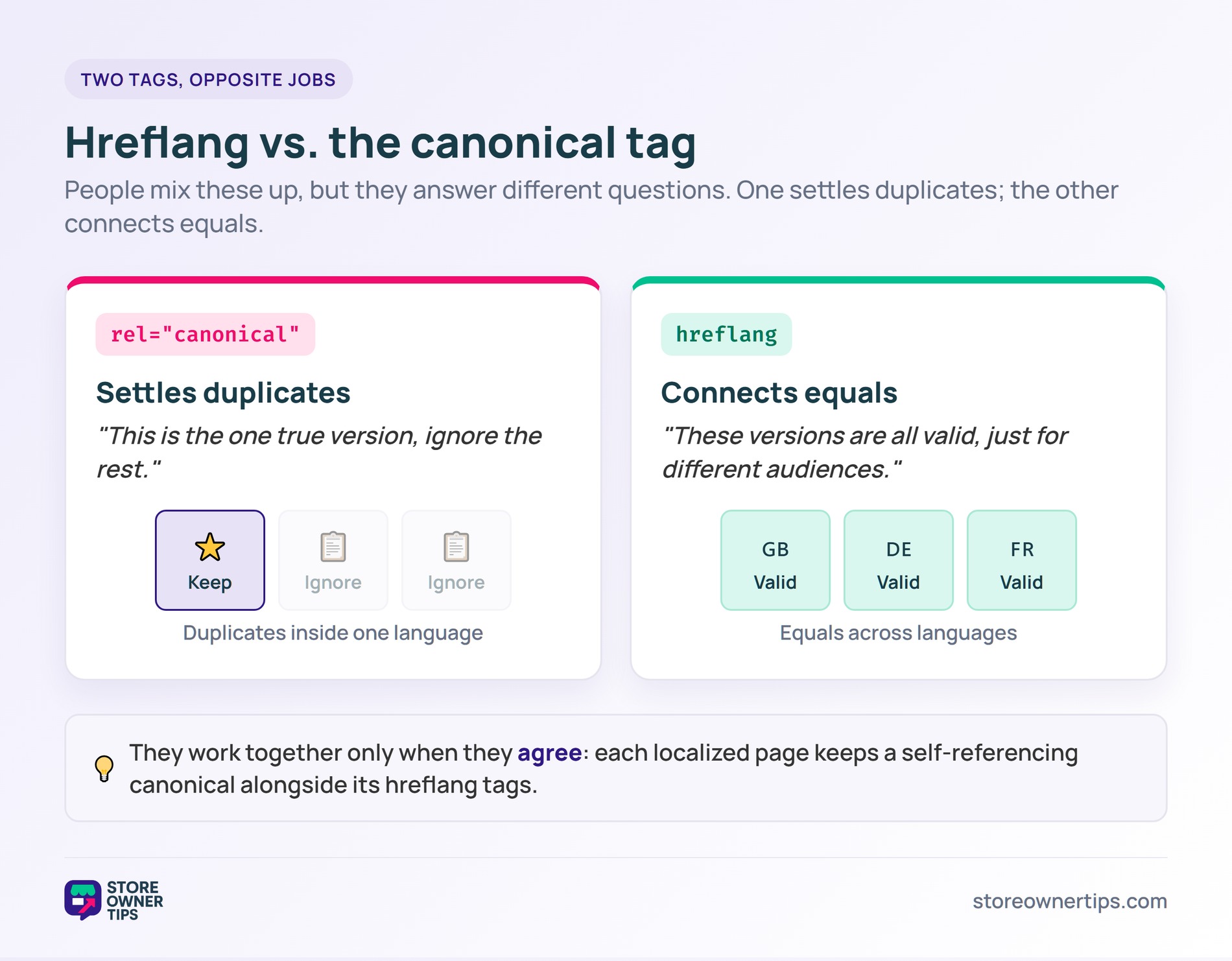
People often mix these up, but they do opposite jobs. A canonical tag says, “This is the one true version, ignore the duplicates.” Hreflang says, “These versions are all valid, just for different audiences.”
They can work together, but they must agree. If your German page points its canonical at the English page, Google sees a conflict. So each localized page should carry a self-referencing canonical alongside its hreflang tags.
A handy way to remember it: the canonical settles duplicates inside one language, while hreflang connects equals across languages. They sit in the same head section, yet they answer different questions. When both line up, search engines trust your setup and route shoppers cleanly.
You have three options, and Google treats them equally. You can place them in the HTML head, in HTTP response headers, or in an XML sitemap. Most WooCommerce or Shopify stores use a plugin or app that adds head tags automatically. Pick one method and stay consistent across your whole site.
Often, yes. If you target both the US and the UK with English pages, hreflang helps Google show the right store to each shopper. You would use en-us and en-gb to separate them. This is handy when prices, currency, or shipping differ by region.
No, and this trips people up. Google reads your page language with its own algorithms, not from hreflang. The attribute only matches each version to the right searcher. So write clear, natural copy in each language, then let hreflang handle the routing.
Usually the tags get ignored, so you lose the benefit. In some cases the wrong page shows in the wrong market. Broken codes, missing return links, and bad URLs are the usual culprits. A quick crawl with an SEO tool will surface most of them fast.
Hreflang is the quiet wiring that makes a multilingual store feel local to every shopper. Get the codes, return links, and canonicals right, and each market sees the version built for it. For any brand selling across borders, that relevance compounds into steady, long-term growth.
Copyright © StoreOwnerTips.com. All Rights Reserved.
