Weekly ecommerce tips, deals & news.
Quantity on Hand (QOH) is the exact, physical number of finished goods sitting on your warehouse shelves right now. It is a literal headcount of the products you actually have inside your building, including both items ready to sell and items already bought but waiting to ship. Think of it as the ultimate anchor of truth for your physical inventory.
To run a successful online store, you need a solid grasp of inventory management and exactly how your platform tracks physical products. Quantity On Hand is the baseline number that all other inventory metrics are built on. It is strictly limited to finished goods.
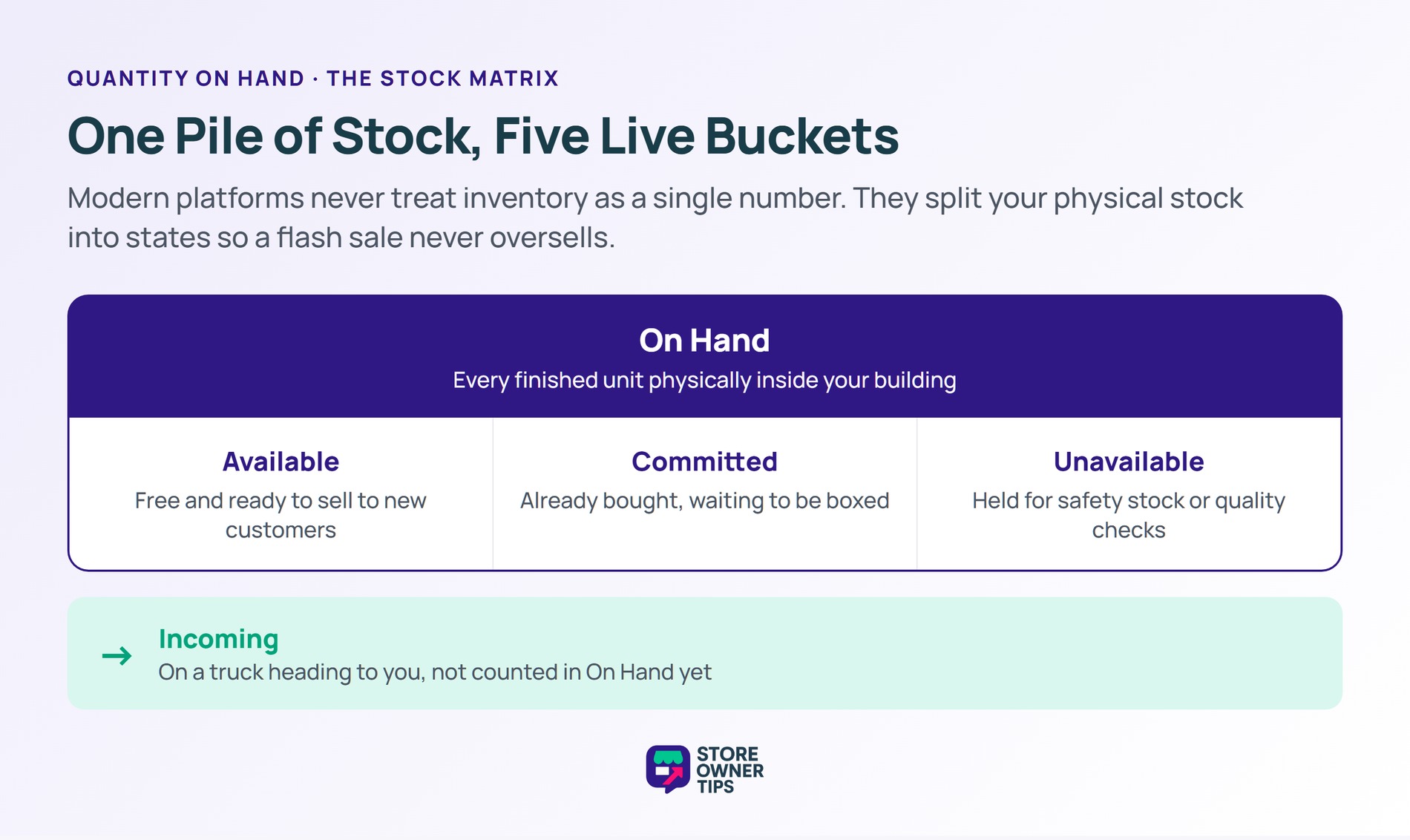
If you sell knitted sweaters, a folded sweater resting in a warehouse bin is one unit of QOH. However, a half-finished sweater still sitting on a sewing machine is known as Work-in-Process (WIP). That unfinished item does not count toward your QOH. QOH is the undeniable, physical truth of what exists within the four walls of your building.
Modern e-commerce ecosystems don’t just treat inventory as a single number. Instead, platforms like Shopify use a multi-state matrix to prevent data crashes during huge traffic spikes, like Black Friday flash sales. Shopify algorithmically divides your stock into different buckets:
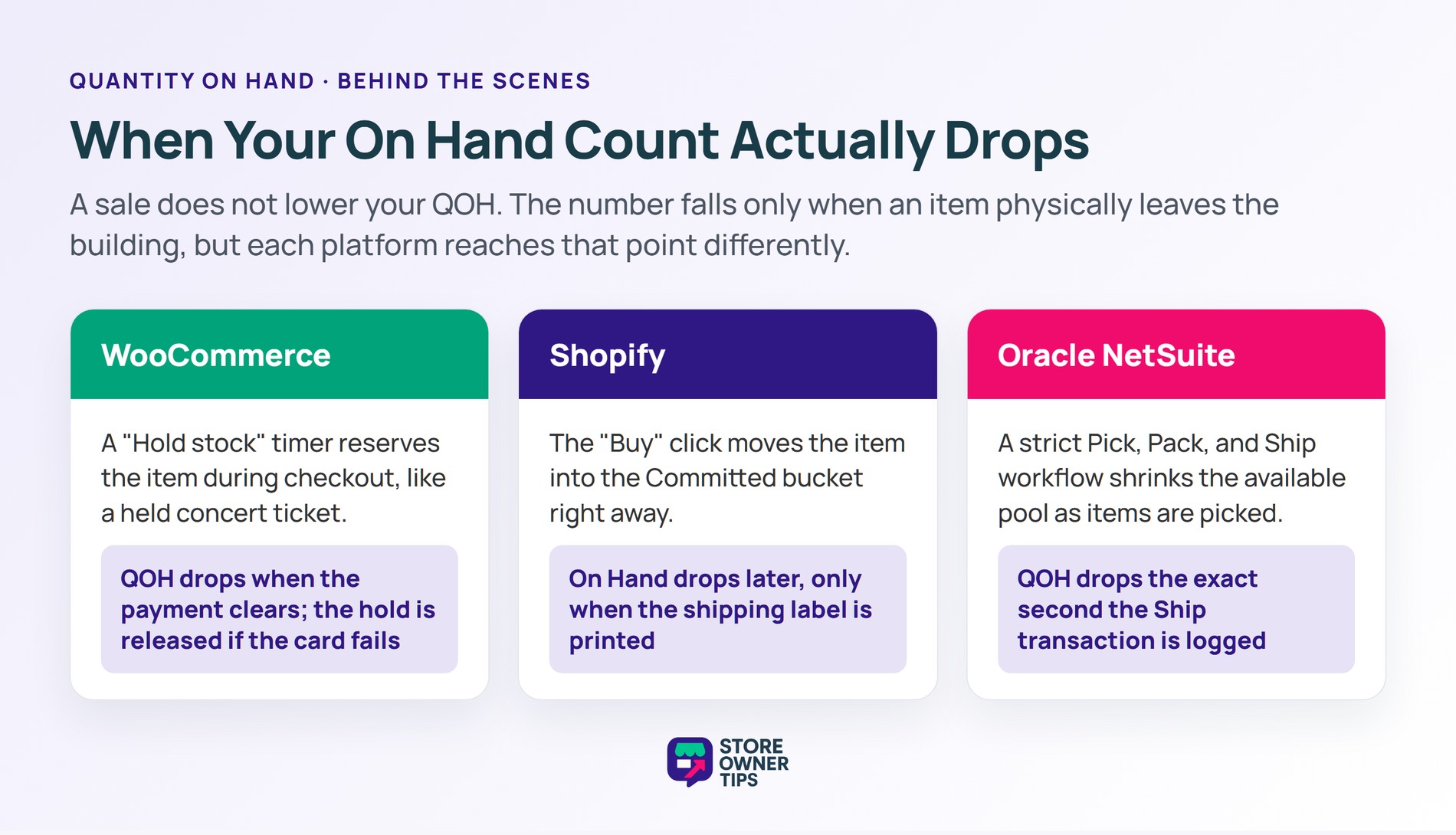
Different platforms handle the exact moment your inventory drops differently. In Shopify, when a customer clicks “Buy,” the system instantly moves that item into the Committed bucket. However, your On Hand number doesn’t change at all. Your QOH only goes down later when your warehouse worker prints the shipping label and the item physically leaves the building.
WooCommerce works a bit differently. It relies on a “Hold stock” timer during the checkout process. Think of this like buying concert tickets online. When you put a ticket in your cart, a timer starts. For those few minutes, the ticket is held just for you. If your credit card goes through, WooCommerce permanently drops the stock. If your card fails, it drops the hold and lets someone else buy it.
Enterprise systems like Oracle NetSuite use a strict “Pick, Pack, and Ship” workflow. When a worker picks an item from a shelf, the available pool shrinks. But the QOH does not drop until the exact second the “Ship” transaction is logged.
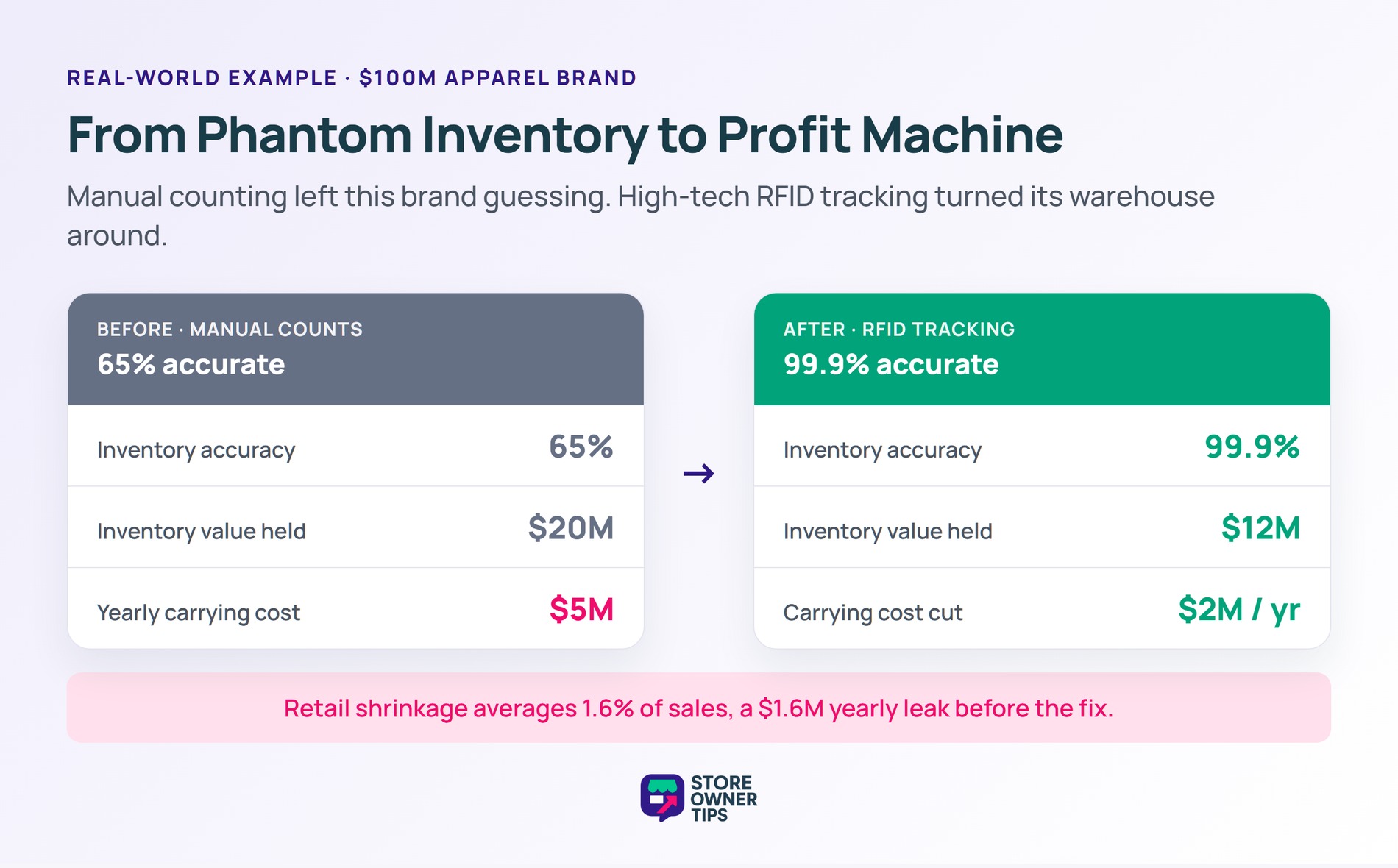
Imagine a mid-sized apparel brand that generates $100 million in yearly sales. To keep up with customer demand, this brand holds $20 million in physical inventory across their warehouses throughout the year.
However, they rely on manual inventory counting. According to industry benchmarks from the Auburn University RFID Lab, standard retail businesses operate with an inventory accuracy of just 65%. This means that for 35% of their catalog, the numbers in their computer database are completely wrong.
This inaccuracy is driven by retail shrinkage. Shrinkage includes consumer shoplifting, warehouse theft, or simple scanning mistakes made by tired employees. Industry averages show that shrinkage eats up 1.6% of total sales. For this brand, that is a $1.6 million loss every single year.
This shrinkage creates “phantom inventory.” Phantom inventory is a dangerous situation where the database claims you have 10 sweaters on the shelf, but the shelf is actually totally empty. Because the computer thinks it has stock, it never orders more. The brand keeps taking orders they can’t fulfill, angering customers and missing out on sales.
To fight these out-of-stock nightmares, the brand’s purchasing team panics. They start manually ordering way too much backup inventory. This traps the brand in a massive overstock crisis.
Inventory carrying costs are brutal. The cost to store, insure, and manage physical goods typically runs 20% to 30% of the total inventory value every year. Taking the 25% midpoint, this brand holds $20 million in excess stock. That means they burn a staggering $5 million annually just to keep boxes sitting on shelves!
To fix this, the brand upgrades their warehouse with Electronic Product Code (EPC) technology, using high-tech RFID scanners to track every single item perfectly. This pushes their inventory accuracy from a miserable 65% up to an optimized 99.9%.
With perfect accuracy, their automatic Reorder Points finally work. They stop panic-ordering and slim their total inventory value down to a highly efficient $12 million. By trusting their precise QOH, they eliminate phantom inventory, cut their yearly carrying costs by $2 million, and turn their warehouse into a profit-driving machine.
Many store owners mix up Quantity On Hand and Available Quantity, but confusing these two metrics is a common inventory management mistake that will cause a massive disaster for your supply chain.
Quantity On Hand is the physical reality of your warehouse. It includes everything under your roof.
Available Quantity is the commercial reality of your website. It is the exact number of items that are unattached, unreserved, and freely ready to be sold to a brand new customer today.
There is a simple mathematical equation that binds these two together:
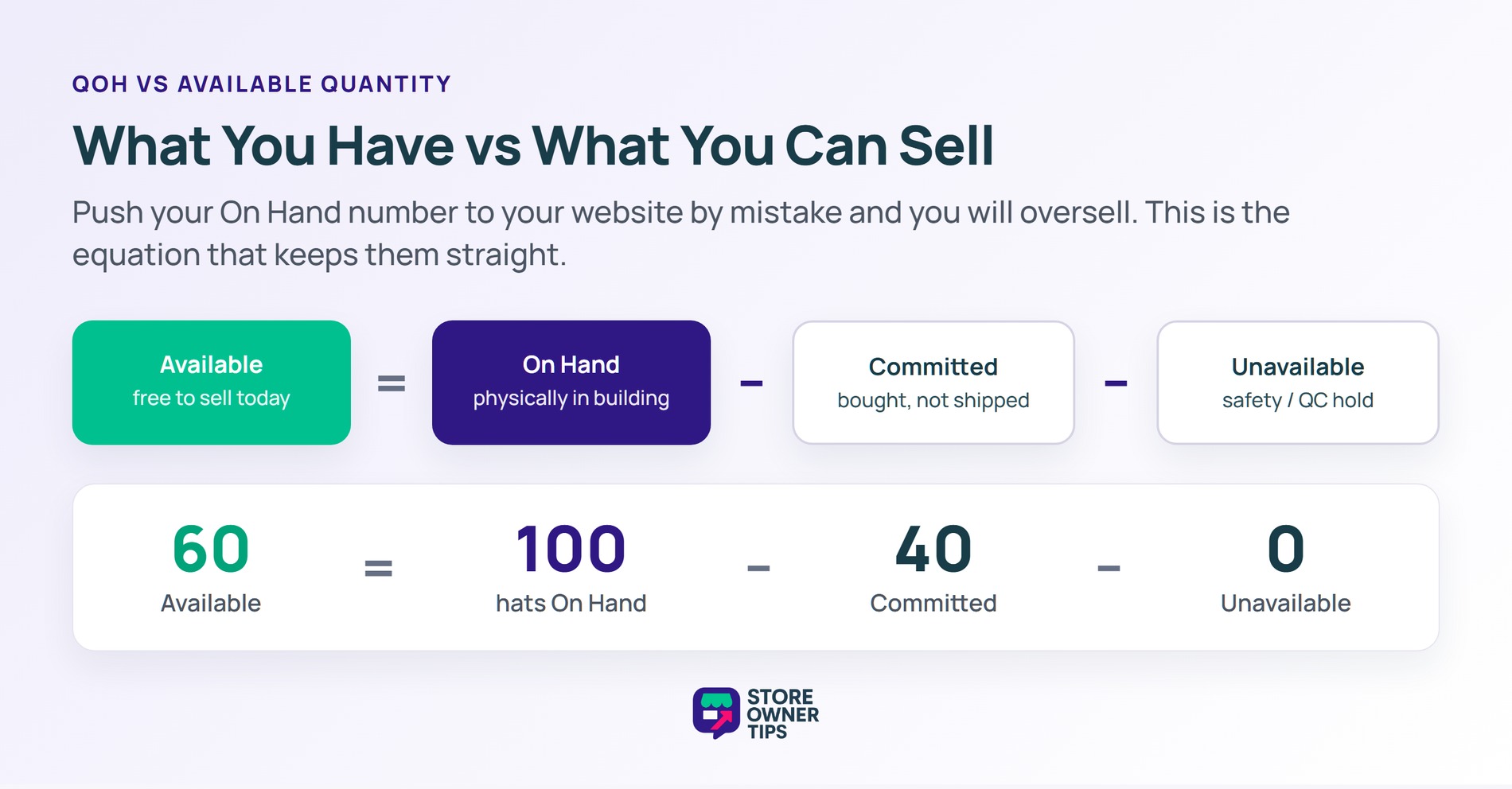
Available Quantity = Quantity On Hand – Committed Quantity – Unavailable Quantity
Let’s look at a practical example. A warehouse worker counts 100 hats on a shelf. Your Quantity On Hand is 100.
Over the last few hours, your website sold 40 of those hats. They haven’t shipped out yet, so your Committed Quantity is 40.
Your system will do the math and tell your website that your Available Quantity is 60.
If you run a bulk inventory update and accidentally push your QOH number (100) to your website instead of your Available number (60), your store will let 100 new people buy the hat. You will end up with 140 orders but only 100 physical hats, leaving you with 40 furious customers and a customer service nightmare.
Advanced sellers use futuristic versions of these metrics. Available-to-Promise (ATP) calculates what you can sell tomorrow by looking at your current QOH and adding the shipments currently on a cargo ship heading your way. Capable-to-Promise (CTP) looks even further ahead, looking at raw materials and factory labor to promise a delivery date for a product that hasn’t even been built yet.
Tracking your QOH perfectly comes with massive rewards, but relying on strict inventory systems brings a few challenges you need to manage.
The Shopify mobile app is designed for warehouse workers who are walking the floor counting physical items, so it prioritizes the “On Hand” view. The mismatch happens because the “Available” stock automatically subtracts any items that were just purchased by customers but haven’t been boxed up yet. To find your true Available number on the app, you have to mentally subtract your unfulfilled, pending orders from your On Hand total.
Standard inventory rules will drop your stock to zero and block the sale. To get around this, you have to separate your physical warehouse from your website. You can do this by setting up a virtual “Pre-Sale Location” in your backend and giving it a fake, inflated QOH like 999 units. This lets customers check out normally. When the real inventory arrives weeks later, you simply update the real “On Hand” numbers to balance the books.
When you upload a spreadsheet to platforms like Shopify, you have to be incredibly careful which column you target. If you force a raw number into the “On Hand” column without adjusting for items already waiting to ship, the system’s math breaks. Modern CSV files require you to map everything perfectly to specific states, like “Incoming” or “Committed.” Overwriting one number without balancing the equation causes massive data corruption.
Quantity on Hand is far more than a simple counting exercise; it is the beating heart of your entire inventory management operation. By mastering the strict difference between what physically sits on your shelf and what is commercially available online, you can permanently eliminate the nightmare of overselling. Keeping your QOH data perfectly accurate is the ultimate key to slashing your holding costs, automating your reordering, and building a brand that customers can trust every single time they click “buy.”
Copyright © StoreOwnerTips.com. All Rights Reserved.
